

Most field-service businesses lose revenue they never see leave. It rarely looks like a crisis - it looks like a normal week where a few calls went to voicemail, a couple of estimates never got a second follow-up, and no one could say which marketing actually booked work. Those small gaps are the leak. Here's where it hides.
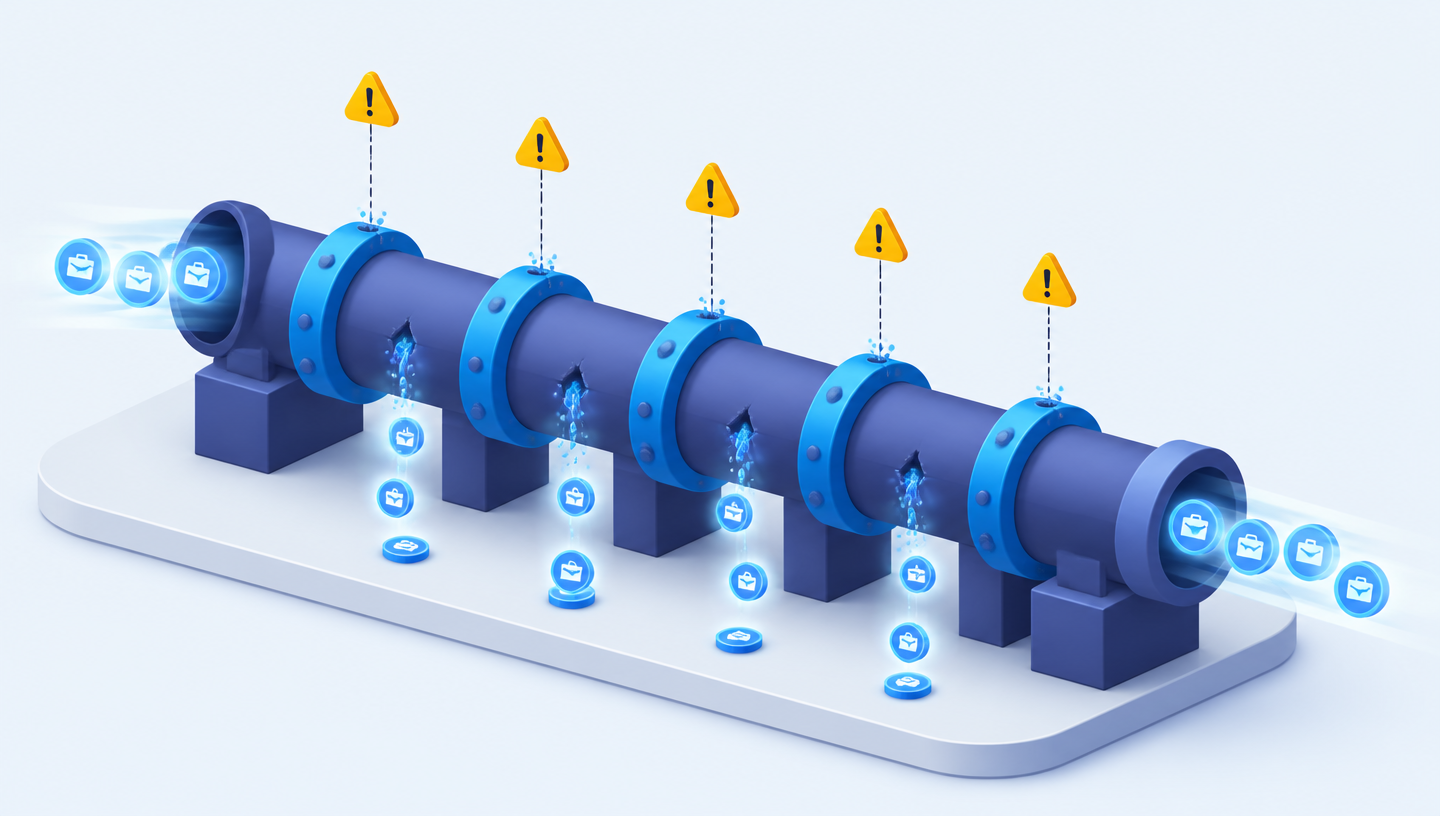
Leaks are not random. In field service they show up in the same five places, in the same order, in almost every company we look at.
1. Missed and after-hours calls
Inquiries hit voicemail while the crew is busy, the office is on another line, or it's after five - and they never get called back. The homeowner does not wait. They dial the next company on the list, and that inquiry never appears in any report because it never became a lead.
This is a lead capture problem, not a marketing problem. The demand already arrived; it just had nowhere to land.
2. Slow or dropped follow-up
The job goes to whoever responded first and kept following up - not whoever does the best work. Most estimates die after a single attempt because everyone assumes silence means no.
Closing this gap is what speed-to-lead is for: instant response plus follow-up that runs until the job books or the lead says no.
3. Rough handoffs
Details get lost between the office and the field - the wrong address, the wrong scope, the note nobody passed along. The result is re-visits, confused customers, and margin that disappears into windshield time.
A clean booking and handoff step keeps the job intact from the moment it is scheduled to the moment the truck arrives.
4. Untracked spend
Budget gets spread thin across everything because no one can tie marketing to booked jobs. Without that line, the channels that book work get cut alongside the ones that never did.
If you cannot say which spend produced last month's booked jobs, you are not optimizing - you are guessing with a budget.
Tracking and ROI ties spend to booked, profitable work so the budget follows the results.
5. No single view
Leads stall unseen because status lives in three inboxes, a text thread, and someone's head. Nothing is technically lost - it's just invisible, which amounts to the same thing.
Pipeline visibility puts every lead in one place with an owner and a next step, so stalls surface before they become losses.
How to find yours
You can't fix a leak you can't see. A revenue-leak diagnostic pinpoints exactly where your booked jobs are slipping - using your own call and booking numbers, not industry averages - so you fix the real gap instead of guessing.
Closing
The leaks are predictable, which means they're fixable. Find yours, then close it with a system that captures every lead, follows up until booked, and tracks what actually books. Systems before software.