
A growth department,
or one engine.
To grow properly, most companies are told to hire a department — a copywriter, a designer, a developer, ads buyers, an SEO, an email person, a content manager, an analyst, and someone to coordinate them. That's tens of thousands a month, and it still leaks in the gaps between them. The alternative is one connected engine that produces the same output, built and run for you.
The roster you'd have to hire
Each of these is a real role with a real salary or retainer. None of them is wrong. The problem is that growth needs all of them, working together, every week.
Copywriter
Writes the words. Doesn't own the result.
Graphic designer
Makes the assets. Waits on the brief.
Web developer
Ships the site. Then it sits still.
Landing-page specialist
Builds the page. Not the follow-up.
SEO specialist
Chases rankings, not booked jobs.
Google Ads buyer
Optimizes clicks handed to a leaky intake.
Meta Ads buyer
Different platform, same handoff problem.
Email-marketing specialist
Sends campaigns. Not the one-to-one follow-up.
Social / content manager
Keeps the feed alive. Feeds nothing else.
Data analyst
Reports the numbers after the money is spent.
A coordinator to hold it together
Or it lands on you.
It leaks in the gaps
Every specialist does their piece well and hands it to the next one. The leads fall between the pieces — the ad brings a call nobody answers, the page collects a form nobody follows up, the analyst reports it a month later. It's the same failure as a pile of disconnected tools, just with salaries attached.
Nobody owns the number that matters
Ten people own ten pieces, and booked jobs belong to none of them — so it lands back on you. The engine exists to close that gap: one connected system, one operator accountable for booked work, measured by what it actually produces.
A growth department vs. one engine
What you're buying
- A growth department
- Roles, hours, and deliverables
- One engine
- An outcome: booked jobs
Who does the work
- A growth department
- A roster of specialists, each in their lane
- One engine
- Agents doing the production, continuously
Who owns the number
- A growth department
- Nobody — every role owns a piece
- One engine
- One human operator
How the pieces connect
- A growth department
- Handoffs, meetings, and follow-up emails
- One engine
- One system — no gaps to fall through
Pace
- A growth department
- Monthly cycles and availability
- One engine
- Continuous, day and night
What you manage
- A growth department
- People, briefs, and coordination
- One engine
- Your business. We run the growth.
What's measured
- A growth department
- Activity delivered
- One engine
- Booked, profitable jobs
Cost shape
- A growth department
- Tens of thousands a month, growing with headcount
- One engine
- A fraction of that, scoped to your operation
The output that roster produced — from one system
Agents do the repetitive production work continuously. A human operator sets the rules, tunes the engine, and owns the booked-job number. Content and ads still get made — they're a byproduct of the engine, not the product you're buying.
Content and pages that keep you findable in search, the map, and AI answers
Ad campaigns built, launched, and adjusted against booked work
Landing pages and offers that match what buyers actually search for
Every call, form, and message caught and answered on the spot
Follow-up that runs until the lead books or gives a clear no
Reporting that ties spend to booked jobs, in plain language
And what about an agency?
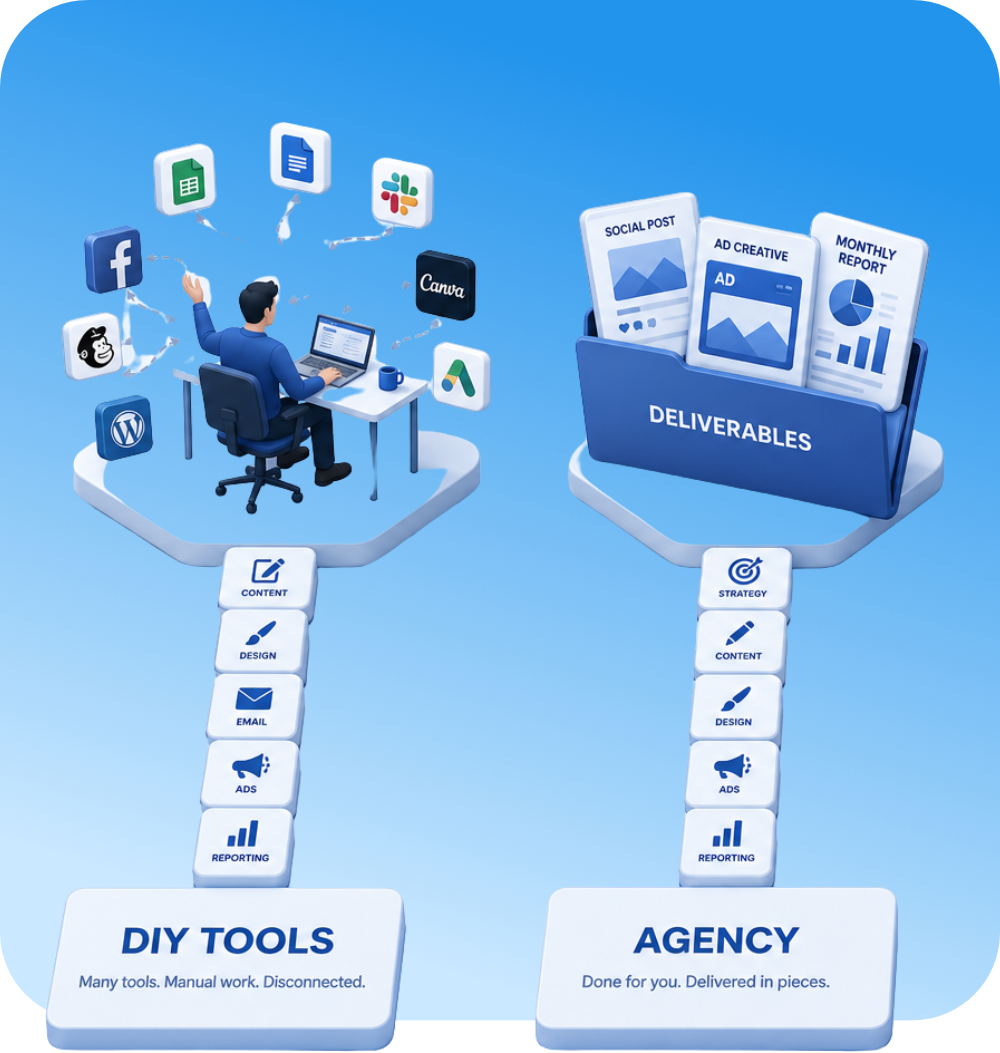
An agency is the roster on a retainer. You buy activity — posts, ads, hours, a monthly report — and the booked-job number stays yours. We're not a marketing agency and not a social-post shop. We're accountable for the outcome: an engine that produces booked jobs, with one operator answering for it.
Replace the roster, or supercharge your people
You don't have the team yet
Instead of hiring and coordinating the roster, you get the output from day one — built, tested, and operated. No job posts, no briefs, no management layer.
You already have people
They stop grinding through production and start working on top of a system that runs without them. Same team, far more output, and a number everyone can see.
A full growth team costs tens of thousands a month
This is a fraction of that, scoped to your operation on the fit call — because what you need depends on how your business runs. No packages, no guessing, and no number until we've looked at yours together.
See where you stand
A revenue-leak diagnostic shows what your current setup is costing you — using your own numbers — before you decide anything.
Common questions
A department sells you roles. An agency sells you activity. The engine is built and run for you — and measured by booked jobs.