

"We need to get faster" is the recurring anthem of service businesses — and the usual fix is to push the team harder. It rarely works, because speed isn't a willpower problem. It's a design problem. You can demand all the urgency you want, but if the process creates friction, you're just asking people to run faster in lead boots. The real lever is designing the work so speed happens by default — and automating the repetitive parts so it sticks.
The reframe: Speed is not a performance trait. It's a system outcome. When a business feels slow, the people usually aren't the problem — the environment is.
Why pushing harder doesn't work
Delays show up through people — an email sits, a quote takes three days, a lead goes cold — so we assume the fix is also about people: more accountability, more urgency, more pressure. But people operate inside systems, and the system decides what's easy and what's hard. If replying to a prospect means checking three spreadsheets and chasing two approvals, that person will be "slow." That's not effort. That's design.
Friction is the invisible tax on speed
Most lost time isn't dramatic. It hides in small moments of uncertainty that repeat all day:
- Who owns this?
- What's the next step?
- Where's the information for this customer?
- Has this actually been reviewed?
Each one costs seconds to minutes. Multiply them across every lead and every handoff, and you've lost hours a week the schedule never accounts for — your team spends its day navigating uncertainty instead of executing.
Your team didn't get slow. The system was always slow — people were just covering the cracks.
The automation trap
When the friction gets painful, businesses reach for automation as a silver bullet. Here's the hard part: automation doesn't create clarity. It amplifies whatever design already exists.
Automate a clear, well-defined process and you get efficiency. Automate a chaotic, ownerless one and you get a high-speed, automated mess. The tool can't define your ownership, set your standards, or fix your confusion.
What to automate — and what to keep human
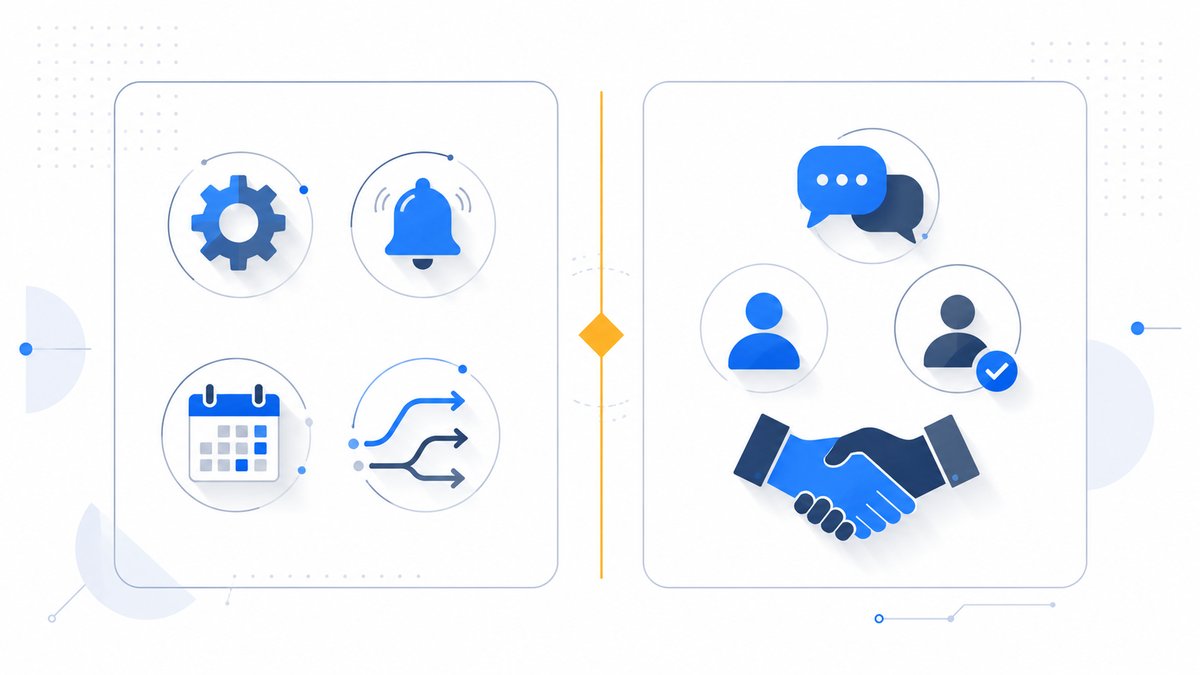
This is how you save hours without making the experience robotic. Automate the repetitive and rule-based. Keep humans on the parts that need a human.
Automate (repetitive, rule-based)
- Lead routing to the right owner
- Reminders and follow-up nudges
- Appointment scheduling + confirmations
- Data entry and record updates
- SLA timers that flag aging leads
- Missed-call text-back
Keep human (judgment, relationship)
- The actual sales conversation
- Complex or custom quotes
- Reading the situation and adjusting
- Handling an upset customer
- Building the relationship
- Anything that needs empathy or trust
Done this way, automation doesn't replace the human touch — it protects it. Your team stops drowning in repetitive admin and spends its time where a person actually changes the outcome.
How to actually make the team faster
The fastest organizations rarely work the hardest. They have the most operational clarity. The sequence is simple, and the order matters:
Skip the first two and automation just makes confusion faster. Get them right and speed becomes a byproduct of the design instead of an exhausting daily push. The same friction that slows your team is where revenue quietly leaks — and clear ownership is also what makes follow-up actually happen.
What to automate first in a service business
If you're not sure where to start, start with the repetitive, rule-based work that runs the same way every time. These are the highest-leverage automations for most service businesses, roughly in order:
- Missed-call text-back. Every missed call triggers an instant "Sorry we missed you — how can we help?" text. This alone recovers jobs that would otherwise call a competitor.
- Lead routing to one owner. Every new lead is auto-assigned to a named person the moment it lands — no shared inbox limbo.
- Appointment reminders and confirmations. Automatic reminders cut no-shows without anyone chasing.
- Follow-up cadence reminders. The system prompts the next touch so follow-up doesn't depend on memory.
- Review requests after the job. An automatic ask at the right moment compounds your reputation over time.
Notice the pattern: every one is repetitive and rule-based. That's the test for what to automate. The judgment calls and real conversations stay with your people.
Rule of thumb: if a task is the same every time and doesn't need a human to decide anything, automate it. If it needs judgment, empathy, or a relationship, keep it human and let automation tee it up.
Systems win
You don't pressure speed into existence. You design it in. Remove the friction, define the ownership, make the next step obvious, then let automation enforce it. Get the design right and a faster team stops being a constant struggle — it becomes how the business runs.