

Most service businesses think they have a follow-up problem. They don't. They have an ownership problem. A lead comes in, everyone assumes someone else has it, and by the time anyone notices, the prospect already hired the company that called back first. A working follow-up system fixes this with one rule and four moving parts — and you can build it in an afternoon.
This isn't about persistence or better scripts. It's about removing the gap where leads quietly fall through.
The reframe: You don't have a follow-up problem. You have an ownership problem. The missed call is just where it becomes visible.
Why most follow-up "fixes" don't work
When jobs slip, the instinct is to push the team: more urgency, more touches, a new CRM, more training. Those treat the symptom. Here's how the real failure actually happens:
Nobody was lazy. Nobody lacked a script. The lead was lost the moment it wasn't clearly owned.
You can't fix with discipline what was never assigned in the first place.
What a lead follow-up system actually is
A lead follow-up system is a defined, repeatable process that decides — before any lead arrives — who owns it, how fast they respond, and exactly what happens next until the lead books or dies. It has four parts:
Get those four right and follow-up stops depending on memory, mood, or who happens to be free.
Step 1 — Give every lead one owner
The first decision isn't how to follow up. It's who. Before a single lead comes in, decide who owns each source: website forms, phone calls, missed calls, texts, Google Business Profile messages, referrals. One named person per source. Not a team. Not an inbox. A person.
The 5-second test: if a lead came in right now, could everyone name who's responsible in under five seconds? If not, that's your leak.
Step 2 — Set a response SLA (speed wins jobs)
Speed to lead is the single biggest lever in follow-up. The business that responds first usually wins — not because it's better, but because it's there while the prospect is still paying attention. A lead is hottest in the first few minutes and cools fast after that.
Step 3 — Run a fixed multi-touch cadence
One call and a shrug isn't follow-up. Most booked jobs come after several touches, across more than one channel. Define the sequence once so nobody has to decide in the moment:
| When | Touch | Channel | Owner action |
|---|---|---|---|
| Within 5 min | Touch 1 | Call | Call immediately. No answer → leave voicemail. |
| Within 5 min | Touch 2 | Text | "Hi [name], it's [you] from [company] — just tried you about [request]. When's a good time?" |
| Same day | Touch 3 | Quick recap + clear next step (quote, call, or booking link). | |
| Day 2 | Touch 4 | Call + text | Second attempt, different time of day. |
| Day 4 | Touch 5 | Text | Light check-in. |
| Day 7 | Touch 6 | "Still want help with this?" + booking link. | |
| Day 10+ | Move | — | Mark dead or drop into long-term nurture. No lead lingers undecided. |
The exact days don't matter as much as having a defined sequence that runs the same way every time.
Step 4 — Put every lead in one place
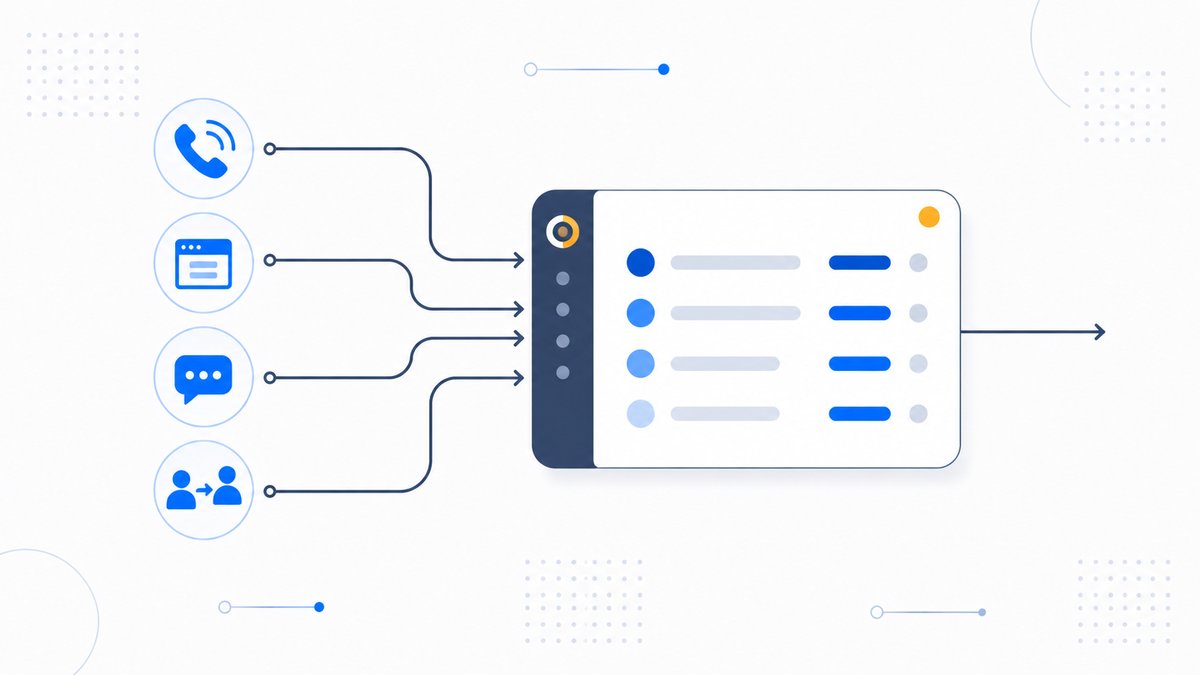
Follow-up dies when leads live in personal inboxes, individual phones, and someone's memory. You can't manage what you can't see. Every lead — from every source — lands in one shared system that shows who owns it, what stage it's in, and when it was last touched. That visibility is what turns a pile of "I think we called them" into a process you can actually run. Visibility is the foundation of control — more on that here.
Where automation fits (and where it doesn't)
Automation makes a good system faster. It can't create one. Automate a chaotic, ownerless process and you just make a high-speed mess.
Once the four parts are defined, automation does the heavy lifting that memory can't: instant text-back on missed calls, the SLA timer that flags an aging lead, the cadence reminders, the routing that drops each lead to the right owner. The system defines the logic. Automation enforces it. In that order.
Why this gets more urgent as you grow
When you're small, you see every lead, so informal follow-up survives. Then volume increases — more leads, more channels, more people — and the cracks that were always there get exposed. The cheapest time to install this system is before the phones are exploding, not during. This is the same pattern behind most lost revenue: it leaks in small drops, not big events.
Growth doesn't create the leak. It reveals it.
How many follow-ups — and how to not be annoying
Two questions come up every time: how many follow-ups is too many, and how do I stay persistent without being a pest? The answer to the first is "more than most businesses do" — the majority of booked jobs come after several touches, and most companies quit after one or two. The answer to the second isn't about backing off. It's about being worth opening.
Persistence isn't what annoys people. Irrelevance is. Here's how to keep following up and stay welcome:
- Lead with something useful each time. A reminder, an answer, a next step — not just "checking in again."
- Vary the channel. Call, then text, then email. The same channel five times feels like nagging; a mix feels like service.
- Space it sensibly. Fast at first while interest is hot, then widening gaps over a week or two.
- Make the next step effortless. A booking link or a yes/no question beats "let me know your thoughts."
- Make stopping easy. A clear "want me to close this out?" respects their time and often re-opens the conversation.
Do that and follow-up stops feeling like pressure. It feels like a business that's on top of things.
The point
Most businesses lose revenue the same way: not in dramatic blowups, but in quiet drops — the missed call, the late quote, the text that got forgotten. Hundreds of small moments that add up to a number you can't explain.
Fix the ownership, set the speed, run the cadence, keep it all visible. That's the system. It's not complicated. It just has to exist before the next lead comes in.