

To prepare your service business for Q4, fix how leads are handled before the volume arrives: response speed, ownership, follow-up, and calendar capacity. Then make the year-end decisions about tools, hires, and budget on purpose instead of in a scramble. Q4 rewards the businesses that tightened the system in September, not the ones that advertised hardest in October.
Most owners treat September as the quiet month before things get busy.
That's exactly backwards.
Calm windows are leverage windows. The easiest time to fix intake, follow-up, and booking rules is when the phones aren't exploding. Once they are, every change feels risky, so nothing changes, and the season runs on whatever process you already had.
Why does Q4 punish unprepared service businesses?
Because Q4 isn't one season. It's two, back to back, and they break different things.
The compression. From mid-September through November, demand arrives fast for most trades. Heating calls the first cold week. Roofing and gutter work before winter. Restoration after the first storms. Cleaning and organizing ahead of the holidays. Homeowners contact several providers at once and hire whoever responds first with a clear next step. Handling decides who books, not visibility.
The slowdown. December softens for many trades, staff takes time off, and the leads that do come in land on a half-staffed office. Those are often the highest-intent leads of the year (something broke, and they need it fixed before guests arrive), and they're the ones most likely to hit voicemail.
The data backs the two-season picture. Jobber's Home Service Economic Report for Q4 2025, built on data from more than 350,000 service professionals, described demand as uneven in October and November followed by a broad rebound in December. For contractors (electrical, plumbing, HVAC), job volume was flat for the quarter while median revenue still grew about 4%, driven by larger, higher-ticket work. Read that carefully: fewer, bigger jobs. When each lead is worth more, losing one costs more.
Layered on top of both: renewals, year-end budget decisions, hiring for next year, and the temptation to buy whatever tool promises to fix the chaos. All of it lands in the same twelve weeks.
Owners who tighten systems in September experience a ramp. Owners who wait experience a scramble.
What actually breaks in Q4?
Under load, service businesses leak in the same five places every year. If you know where they are, you can fix them in advance. (The full map of where jobs slip between inquiry and booking is here: Why Revenue Leaks.)
- Missed calls during peak hours. The office is on another call. The tech is on a roof. The lead calls the next name on the list. A widely cited 411 Locals study (2016) put unanswered calls to small businesses at 62%, and BIA/Kelsey research found 85% of callers who can't reach a business won't call back.
- Web forms and after-hours requests that wait. Jobber's booking data shows 41% of jobs booked online arrive after hours. A form submitted at 8pm and seen at 9am is a lead that has already booked elsewhere.
- Estimates nobody chases. Replacement and repair decisions take days. Without follow-up, the quote quietly expires.
- Handoffs to seasonal help. Temp staff and new hires don't know who owns what. Leads fall between people.
- No visibility. The owner can't see how many calls were missed or how many quotes are open, so the leak isn't discovered until the season is over.
None of these are marketing problems. All of them are system problems, and every one is fixable before October.
What's the month-by-month Q4 preparation plan?
| Month | Focus | The work | The number to watch |
|---|---|---|---|
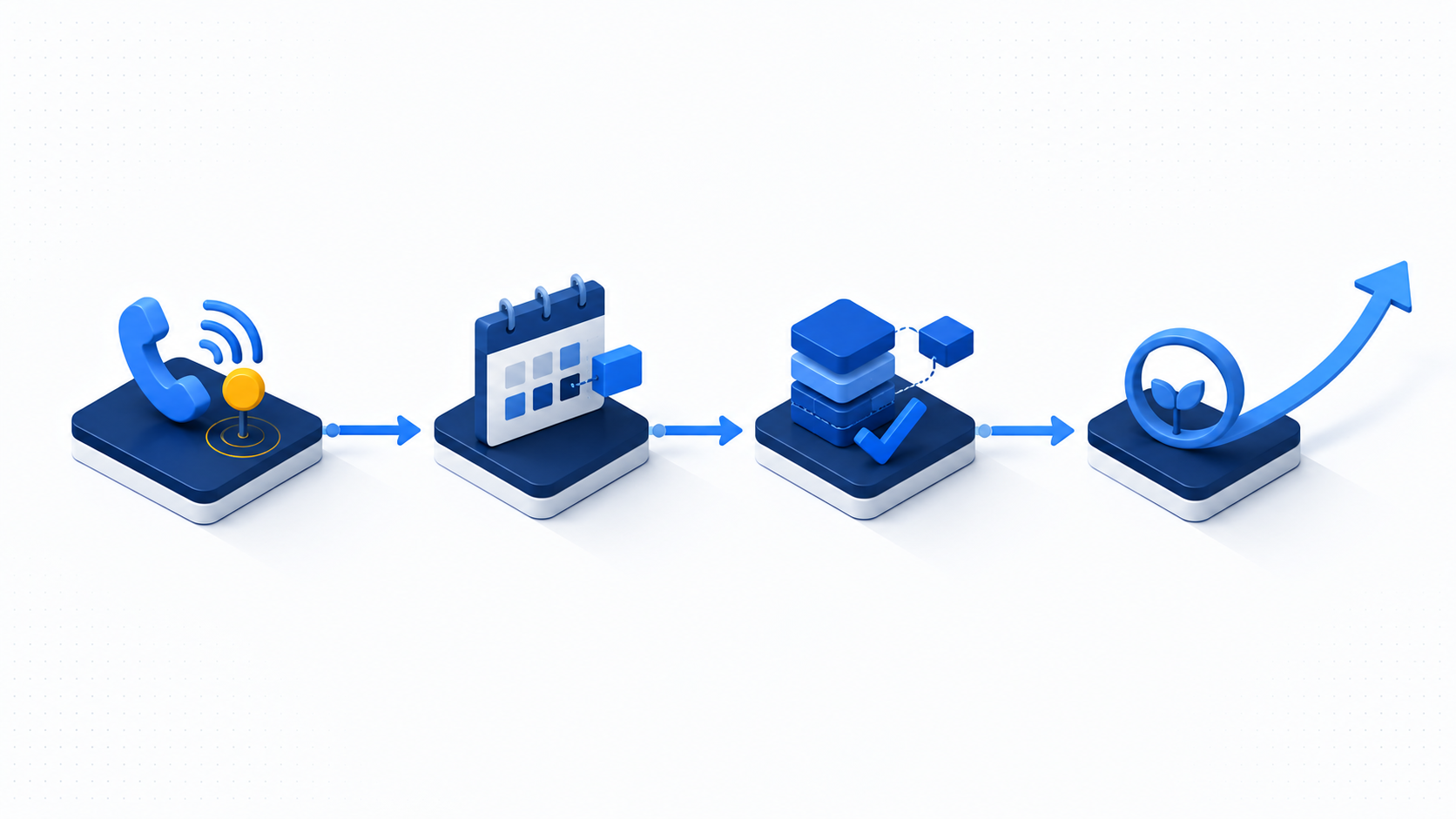
| September | Fix handling | Response SLA, missed-call text-back, one owner per lead, follow-up cadence, one system of record | Minutes from inquiry to first response |
| October | Fix capacity | Calendar capacity, no-show recovery, estimate follow-up until booked, handoff rules for seasonal staff | Booked jobs per week vs. leads in |
| November | Year-end decisions | Tool audit before renewals, Q1 budget, hiring plan, the "does AI belong here?" test | Monthly tool spend vs. tools actually used |
| December | Set up Q1 | Past-customer reactivation, review requests, Q1 offers and calendar, planning in the calm | Jobs booked for January before January |
September: fix how leads are handled before the phones ring
This is the month that decides the quarter. Four moves, in order.
Set a response standard and build to it. Decide the number: every inquiry gets a first response within five minutes, on every channel, including after hours. That number isn't arbitrary. The research behind it goes back to a 2007 MIT study with InsideSales.com (James Oldroyd) that found the odds of qualifying a lead drop about 21 times between a five-minute response and a thirty-minute one. Harvard Business Review's 2011 follow-up audited 2,241 U.S. companies: only 37% responded to a test lead within an hour, 23% never responded, and firms that answered within the hour were roughly seven times more likely to have a meaningful qualifying conversation than those that waited even an hour longer.
Homeowners say the same thing in their own words. Housecall Pro found 97% of homeowners say response speed and transparent pricing influence which contractor they choose, and CallRail's home services data puts responsiveness among the top hiring factors for 64% of customers.
Then ask honestly whether your current setup can hit five minutes at 6pm on a Tuesday in October. Most can't without automation, which is why missed-call text-back and automated form response are the single highest-leverage fixes available. (How to evaluate those options: Best AI Agents for Lead Capture and Follow-Up.)
37%
the share of companies that responded to a new lead within an hour in Harvard Business Review's audit of 2,241 firms. Nearly a quarter never responded at all. The bar is low. Clearing it is a system decision, not a talent decision.
Name one owner per lead. Not "the office." A person. When a lead comes in, whose name is on it, and what's the next action? If two people think the other one has it, nobody has it.
Write the follow-up cadence down. Day 0, day 1, day 3, day 7. Quotes get chased until the customer books or says a clear no. If it isn't written and automated, it runs on memory, and memory is the first thing that fails when volume doubles.
Consolidate to one system of record. Every lead and every conversation in one place, not across a phone, three inboxes, and a notepad. This is what makes the other three moves possible and what gives you visibility in November when you need to know what actually happened.
Run the math while you're at it. Illustrative only: if you miss 10 calls a week in October and 3 of them were real jobs at a $400 average ticket, that's $1,200 a week, or roughly $15,000 across the quarter, from one failure point. Plug in your own numbers. That figure is the budget for fixing it.
October: capacity and follow-up
Demand is arriving. The September work is catching it. October's job is making sure caught leads become booked jobs.
Check calendar capacity against the forecast. If the calendar can't absorb the volume, booked work becomes delays, and delays become cancellations. Decide now what gets prioritized when the week is full: emergency repairs over tune-ups, replacement conversations over maintenance.
Recover no-shows and reschedules automatically. Every missed appointment gets a same-day reschedule attempt. This is easy to automate and almost never is.
Follow estimates until they close. Open quotes are the largest pile of hidden revenue in most service businesses in October. Someone, or something, chases every one on a schedule.
Set handoff rules for seasonal staff before they start. What a temp answers, what they escalate, and to whom. New people inherit whatever process exists. If the process lives in the owner's head, they inherit nothing.
Don't hire to patch a broken system. Adding people to a process with no ownership rules and no follow-up cadence adds cost and confusion in the same move. Fix the process, then decide whether you still need the hire.
November: make year-end decisions on purpose
November is when tool renewals, budgets, and next year's plan all come due. Three deliberate moves beat three reactive ones.
Audit the tool stack before the renewals hit. List every subscription. Next to each, write what it actually does for the business and who uses it weekly. Most owners find they're paying for five tools that each solve 5% of the problem. That's the Complexity Tax: the hidden cost every added tool, step, and handoff charges the business, every time the process runs. Cut before you add. (The case for that order: Systems Before Software.)
Set the Q1 budget with October's numbers, not October's feelings. You now have real data from a peak month: leads in, response time, booked rate, open quotes. Budget from that.
Answer the AI question with a test, not a demo. For any process you're considering automating: can you describe it on one page, does it run the same way each time, and does the data it needs live somewhere reachable? Three yeses means it's ready. Any no means clean it first. The full roadmap is here: How to Start Using AI Agents in Your Business.
Clear the decision debt. Every "we'll deal with it after the season" decision is a decision deferred with interest. November is when the pile gets paid. Hiring, pricing, the tool you've been meaning to cancel, the process you've been meaning to fix. Write the list, decide each one, and stop carrying it into Q1.
December: set up Q1 so January isn't a restart
The slow month is the build month.
Reactivate past customers. A short message to everyone you served this year: a seasonal check, a maintenance reminder, a January offer. Past customers are the cheapest demand you'll ever generate and most businesses never contact them. Jobber's Q4 2025 data showed December delivering the strongest rebound of the quarter across segments; a reactivation message timed for early December meets that demand instead of missing it.
Ask for reviews from the season's happy customers. Q4 produced your best work of the year. Collect the proof while it's fresh. It feeds next year's search and AI-answer visibility.
Book January before January. Pre-schedule maintenance and follow-up work into the first weeks of the year so the calendar isn't empty on the 2nd.
Plan in the calm. Whatever you learned in October about where the system strained, fix it now, in the window where every change is low-risk. That's the same calm-window logic as September, one quarter later.
What should you NOT do in Q4?
- Don't buy new tools in October. Mid-season is the worst possible time to change how leads flow. Decide in November, install in December or January.
- Don't launch bigger ad spend into a leaky funnel. More leads into a system losing 30% of them just raises the ad bill. Fix handling first, then buy volume.
- Don't hire to patch a process. See above.
- Don't automate confusion. Automating a broken process just breaks it faster and at higher volume, which in Q4 means at the worst possible time.
- Don't wait for the slowdown to plan. By then you've paid a full season's worth of leak.
How do you know you're actually ready?
Five questions. Answer them honestly by mid-September.
- When a call is missed at 6pm, what happens in the next five minutes, automatically?
- Whose name is on every open lead right now, and what's the next action?
- How many estimates are open and unchased at this moment? (If you can't answer, that's the answer.)
- Can a new hire read the intake and follow-up process on one page?
- Which tools would you cancel tomorrow if the renewal came due today?
Five clear answers means you're ready. Fewer than that, and you've just found your September work.
Sources
- Jobber, Home Service Economic Report: 2025 Review and 2026 Outlook (February 2026): Q4 2025 demand pattern and segment results.
- Oldroyd, McElheran, Elkington, The Short Life of Online Sales Leads, Harvard Business Review (2011): 2,241-company response-time audit.
- Oldroyd / InsideSales.com, MIT Lead Response Management Study (2007): 5-minute vs. 30-minute qualification odds.
- CallRail, Home Services Marketing Statistics: responsiveness as a hiring factor (CallRail), after-hours bookings (Jobber), response speed and pricing (Housecall Pro).
- 411 Locals (2016) and BIA/Kelsey: unanswered-call rate and callback behavior, as compiled in industry missed-call research.