
Judging any AI tool requires checking three things: input handling, output speed, and integration fit. Slaidel Consulting's Revenue Engine applies the same test: every agent sits inside one connected system, from lead capture through tracking, so pipeline visibility is measured, not promised.
Judge any AI tool with one question: does it own a business outcome, or just produce output?
Judging any AI tool starts with one question: does it own a business outcome, or just produce output? A 30-minute fit call model applies this test, reviewing where demand comes from, how fast leads get captured, and where jobs slip. Tools that require constant owner oversight fail. Systems that operate independently, like an installed revenue engine, pass.
Why Do Most AI Tool Evaluations Fail?
Most evaluations fail because buyers start with software instead of the business problem. Decision-makers open a demo, compare features, and sign a contract before anyone maps where revenue actually leaks. That sequence gets the order backward.
A sound evaluation starts with questions, not a product tour. Where is time being lost? Where does growth still depend entirely on the owner picking up the phone? Skipping that step is why so many AI tools for service businesses end up unused six months after purchase.
Confusion compounds the problem. The service businesses that grow aren't the ones with the largest stack of subscriptions. They're the ones running on one coherent system that someone actually owns. Collecting tools creates the appearance of progress while the underlying leak stays open.
What separates a good AI evaluation from a bad one?
A good evaluation stays grounded in real adoption data instead of hype cycles or vendor claims. Analysis built on large-scale, real-world adoption patterns across dozens of countries carries more weight than a sales deck promising instant results. Buyers who skip that grounding tend to chase whatever tool is trending that quarter.
Why do purchased tools sit unused?
Tools sit unused because no one owns the outcome. AI automation for home service businesses only works when it's installed as part of a system, not bolted on as a standalone app. Without a clear owner tracking booked jobs against spend, even well-built AI agents for business operations drift back to manual, inconsistent follow-up within weeks.

What Separates a Tool From an Agent?
A tool executes a task when someone tells it to. An agent operates inside a system that decides what happens next without waiting for a prompt. That distinction determines whether a home service business books more jobs or just collects more software subscriptions.
Most vendors selling AI tools for service businesses are selling activity, not outcomes. A vendor hands over a dashboard, a chatbot, or an automation script and calls the job finished. An operator sells the outcome itself, the booked job, not the deliverable. Posts published, hours logged, monthly reports filed: none of that equals revenue. A retainer buys those things. The booked-job number stays the owner's problem to track down alone.
Why does an AI agent need a system around it?
An agent without a system is a fast typist with no manager. AI agents for business function as the workforce inside an engine, but the structure around them, routing rules, follow-up discipline, pipeline tracking, decides whether their output becomes revenue or just noise in an inbox.
Does AI automation replace the need for a system?
No. Automation moves work faster; it doesn't decide what that work should accomplish. Effective AI automation for home service businesses follows a principle worth repeating: technology should serve the business, not the reverse.
| Tool / Agency Model | Agent / Operator Model |
|---|---|
| Sells activity (posts, hours, reports) | Sells the outcome (booked jobs) |
| Software runs when a person operates it | System runs continuously, decides next steps |
| Deliverables measured monthly | Revenue measured in real time |
The gap between these two models isn't cosmetic. It's the difference between paying for effort and paying for results.
How Do AI Agents Fit Into Daily Operations?
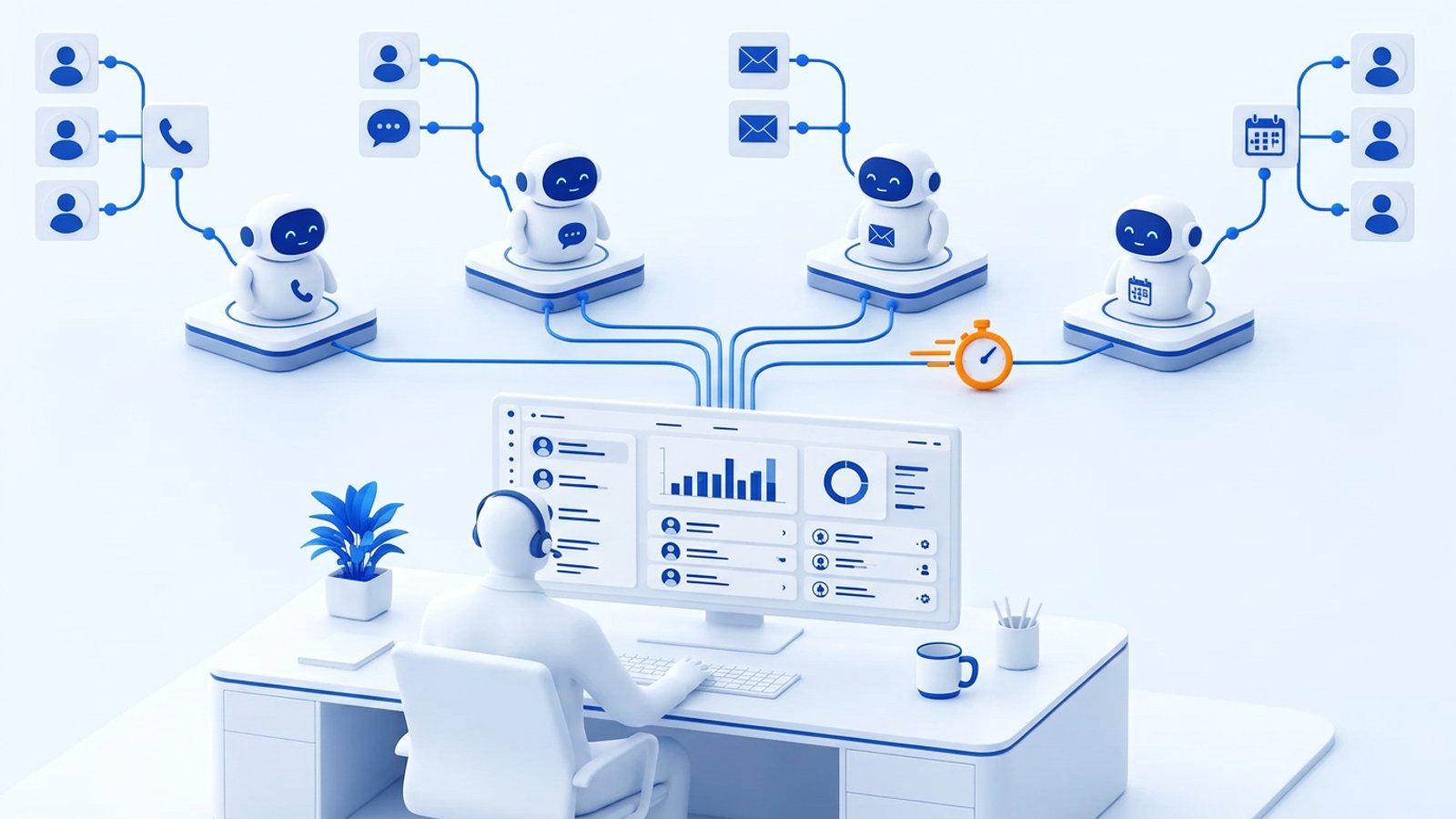
Daily operations split into two layers: repetitive execution and human accountability. AI agents for business handle the rule-based tasks, routing calls, sending follow-ups, updating job status, while a human operator stays responsible for the outcome. Nobody hands the business over to software and walks away.
That division matters because AI tools for service businesses only produce results when someone owns the number they're supposed to move. Agents don't get blamed for a missed callback. Operators do. The rules get set by a person, the execution gets handled by the system, and the accountability never shifts.
AI automation for home service businesses works best when it's connected, not scattered. A demand source, a lead response step, a follow-up sequence, a booking calendar, and a measurement dashboard, stitched into one operation instead of five disconnected tools.
| Layer | Manual approach | Connected system |
|---|---|---|
| Lead response | Inconsistent, delayed | Immediate, rule-based |
| Follow-up | Depends on memory | Runs on a schedule |
| Booking | Tracked loosely | Logged automatically |
| Measurement | Reviewed monthly | Visible continuously |
How many people does it take to run an AI-driven operation?
Fewer than most owners assume. One organization operating heavily on AI reports a global operation run by a small team supported by AI agents. That same organization states plainly that it doesn't study AI in theory, it runs its operations on it.
Does adding agents mean losing control of the business?
No. The structure works in reverse, agents execute, the operator directs. Control tightens because every step gets logged and reviewed, rather than living in someone's inbox or memory.
Where Does Tool-Collecting Quietly Drain Revenue?
Tool-collecting drains revenue by scattering the same lead across five disconnected apps that never talk to each other. A scheduling app catches the call. A separate CRM stores the contact. An ad platform reports clicks with no link to booked jobs. Nothing owns the outcome, so leads fall through the gaps between systems instead of through any single failure point.
Content and ads still get produced inside a working operation. That output should be a byproduct, not the product a buyer is paying for. Ad spend and blog posts feel productive. Neither one closes a job on its own. A connected system carries a lead all the way to the point of sale, then hands the close to the team. That behaves nothing like a shelf of isolated point tools each doing one narrow task.
Is buying more software the fix for a broken sales process?
No. More software adds more places for a lead to get lost, not fewer. The gap closes by installing one connected system around the business, not by layering another isolated tool onto the pile.
What should a service business actually hold accountable for revenue?
Booked work, not activity. AI agents for business can publish content, chase follow-up, and adjust ad spend around the clock. A working system stays accountable for turning that ongoing activity into jobs on the calendar. Without that accountability, AI tools for service businesses and AI automation for home service businesses just become more subscriptions competing for attention. Busywork dressed up as progress, while the revenue leak stays open.
What Should You Actually Ask Before Buying?
Buyers evaluating AI tools for service businesses should ask one question before signing anything: which link in the demand-to-booked-job chain is actually broken?
That's the only metric that matters.
Conclusion
The 60-second test cuts through noise: Does the tool solve a real revenue leak, or does it just add another tab to your browser? Real systems move jobs from inquiry to booked appointment. Everything else is distraction. Judge what actually lands in your pipeline, not what the vendor promises. That's the only metric that matters.
Related reading: start with why revenue leaks, see what a Revenue Engine is, read how a revenue engine works in plain English here, and review our services and install process.