
The first real cold night of the season is the busiest night an HVAC company's phone has all year. It almost never happens during business hours. It happens at 9 PM on a weeknight, when the office is dark, the dispatcher is home, and one tech is on call. Whether you use an HVAC answering service, a rotation, or your own cell phone, that night tells you exactly how your after-hours coverage works. Most owners only find out the next morning.
This post walks through that night from both sides of the phone, and what it looks like when it's handled well.
What the first cold night looks like from the homeowner's side
It's 9:15 PM. The thermostat says 61 and dropping. The furnace clicks, tries, and quits. There are kids asleep upstairs and the forecast says 28 by morning.
The homeowner does what everyone does. They search "furnace repair near me," open the map, and start calling down the list. They're not shopping on price tonight. They want someone to pick up, tell them what happens next, and give them a time.
The first company goes to voicemail. The second plays a message about business hours. The third picks up, asks two questions, and says the on-call tech can be there by 10:30, or first thing at 7 if the house will hold.
The homeowner books the third company. They don't call back the first two in the morning, because they don't need to.
What it looks like inside an HVAC company at 9 PM
Now the same night from your side.
The office phones forward to the on-call tech, or to a service that takes messages, or to voicemail. The on-call tech is already at a no-heat call across town, with his hands in a furnace and a homeowner standing next to him. His phone rings. Then again. He can't stop the repair to pick up every call. Some he answers between jobs. Some he can't. Some go to voicemail, and a few of those callers leave a message.
At 7 AM, the dispatcher walks in to a stack of voicemails and message slips. Some are real emergencies from last night that already got handled by someone else. Some are maintenance requests that could have been booked last night in two minutes. A few are from people who called once, heard a recording, and never left a name.
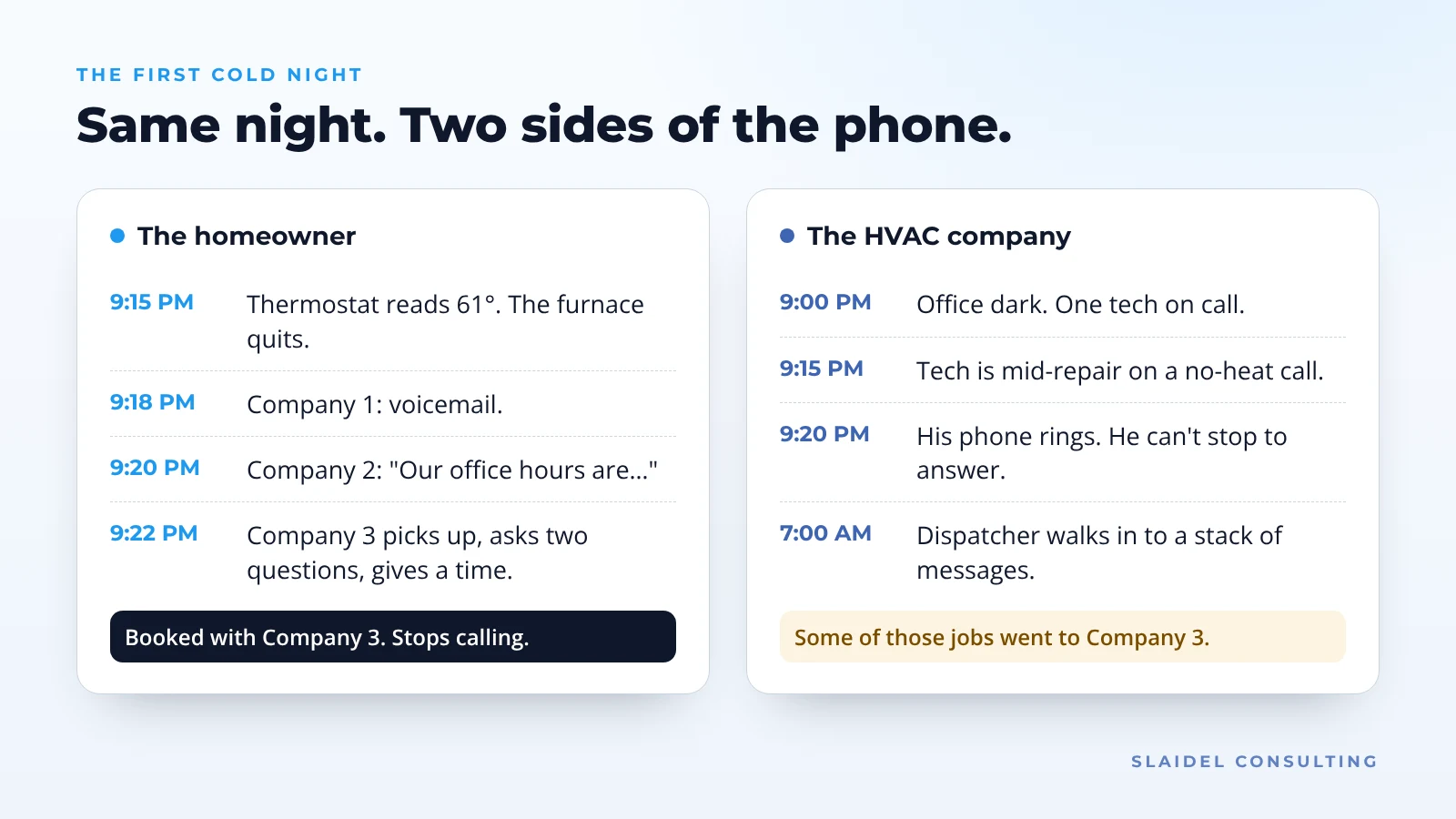
Nobody did anything wrong. The tech worked hard. The office opened on time. But the company was set up to answer the phone during business hours, and the busiest night of the year happened after them.
No heat, no cooling, maintenance: sorting calls by urgency
The first step to covering that night well isn't more people. It's a clear way to sort every call the moment it comes in. Three buckets cover almost everything:
Urgent tonight. No heat with cold weather coming, a gas smell (which goes to the gas utility and 911 first), a system that's making alarming noises, a vulnerable person in the home. These go to the on-call tech now, with the details already written down.
First thing tomorrow. No heat but the house will hold, a system short-cycling, a homeowner who would rather wait for daylight. These get booked onto tomorrow's schedule tonight, with a confirmed time, so the homeowner stops calling around.
Can wait. Tune-ups, a quote for a new system, a question about a filter. These get booked or answered without anyone waking up.
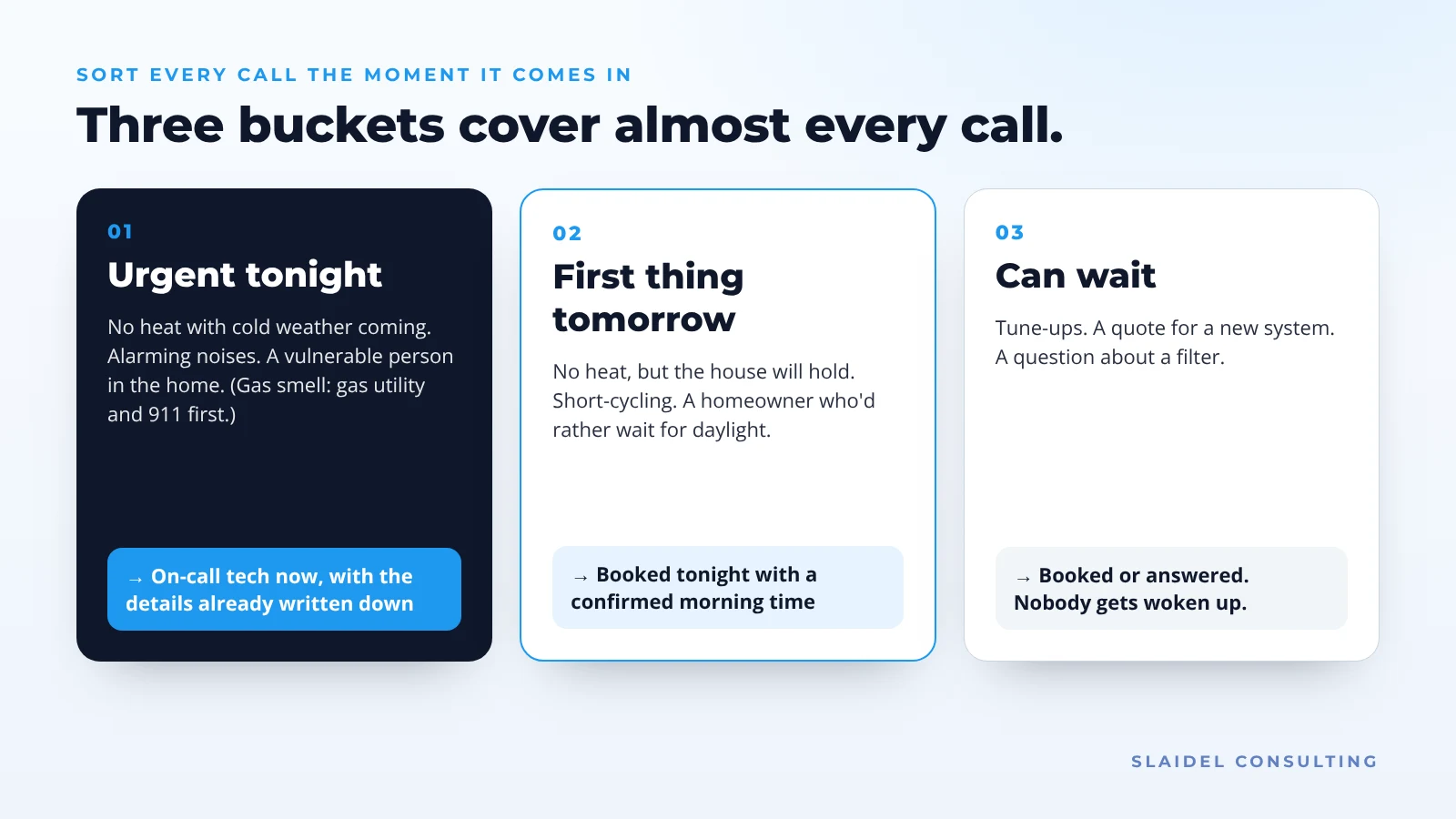
When every call is sorted this way, the on-call tech only hears about the calls that need him tonight, and every other caller hangs up with a time on the calendar instead of a voicemail.
Three ways HVAC companies cover the phones after hours
Most HVAC companies end up with one of three setups. Each one works for some companies and not for others.
The on-call tech takes everything. Calls forward straight to the tech's cell. It costs nothing extra and the homeowner talks to someone who knows the equipment. It breaks down when the tech is on a job, when two calls come in at once, and when the same person has answered the phone every cold night for a month.
A message-taking service. Someone picks up, takes a name and number, and passes it along. Better than voicemail, because the caller hears a person. The gap is what happens next: if the message just waits for the tech or the office, the homeowner is still waiting, and still calling around.
A front desk that answers, sorts and books. Whether it's a trained answering team or an AI receptionist that clearly says it's an AI, the job is the same: pick up every call, ask the right questions, send the urgent ones to the on-call tech with the details, and book everything else straight onto the schedule. The on-call tech becomes the backup for real emergencies instead of the front line for every call.
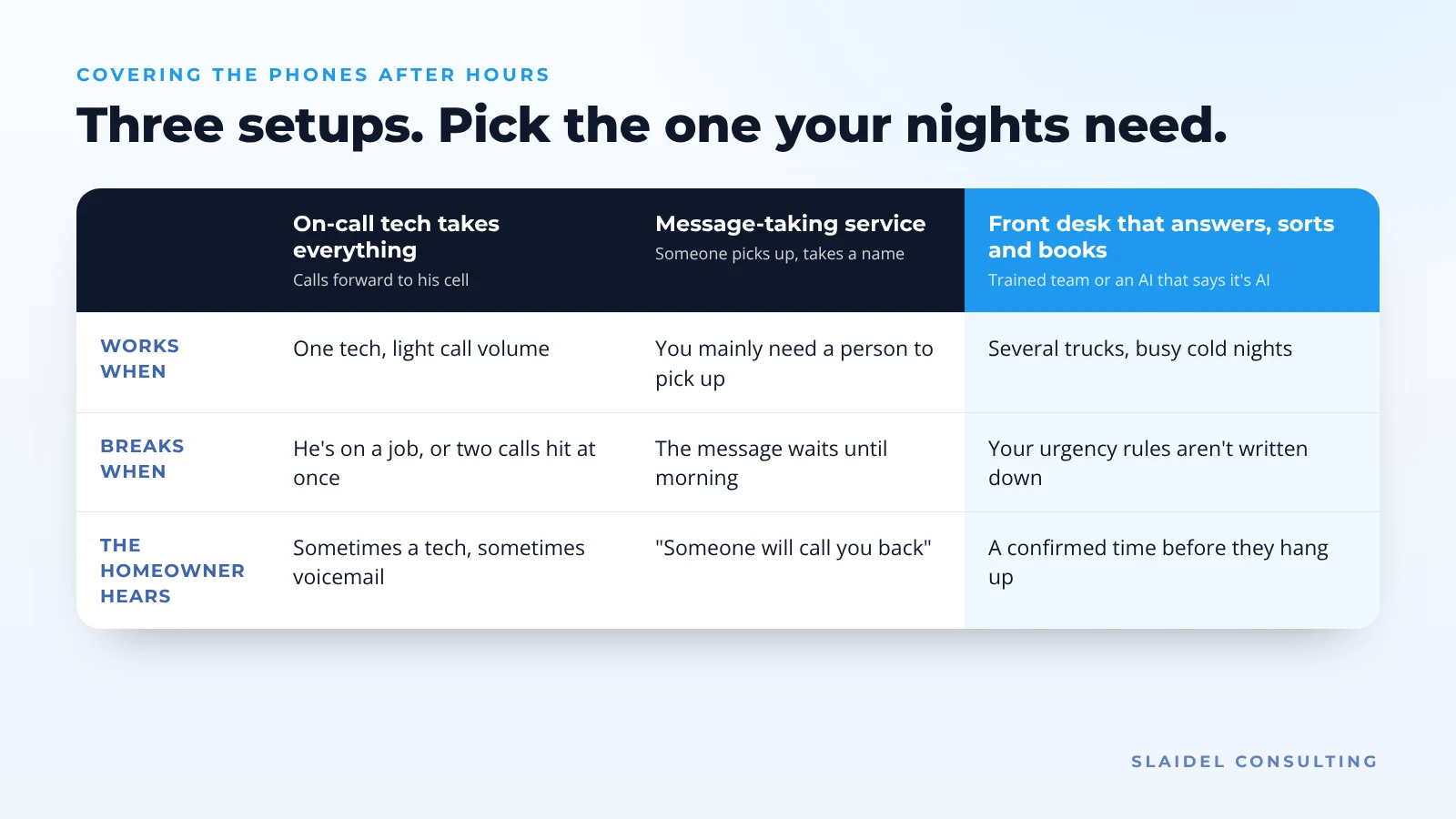
There's no single right answer. A small shop with a dedicated on-call tech may be fine with the first. A company running several trucks into the first cold snap usually needs the third.
What an HVAC answering service should do beyond taking a message
If you're looking at an HVAC answering service, or checking the one you have, the question isn't whether someone picks up. It's what happens after they do. A good one should:
Sort by urgency using your rules, not theirs, so the on-call tech isn't woken up for a filter question.
Collect the details before anyone gets dispatched: address, system type if they know it, what the system is doing, who's home, and the best number.
Book the call onto your real schedule when it can wait until morning, with a confirmed time the homeowner hears before they hang up.
Send a written summary to the on-call tech and the office, so nothing lives only in someone's memory.
Follow up on callers who hung up before finishing, with a text that gives them a way to book.
Sound like your company, with your name, your service area and your way of talking to customers.
If what you have only does the first part, you're paying for a polite voicemail.
What to check the morning after the first cold night
The first cold night is the best test you'll get all year, because it's real. The morning after, sit down with your office lead for fifteen minutes and look at three things:
Every call that came in after hours. Not just the messages. Pull the call log and count the calls, including the ones that hung up.
What happened to each one. Booked, dispatched, answered with a callback time, or nothing. The "nothing" pile is the one that matters.
How the on-call tech's night went. How many times was he called for something that could have waited? That's the number that tells you whether your team makes it to January in good shape.
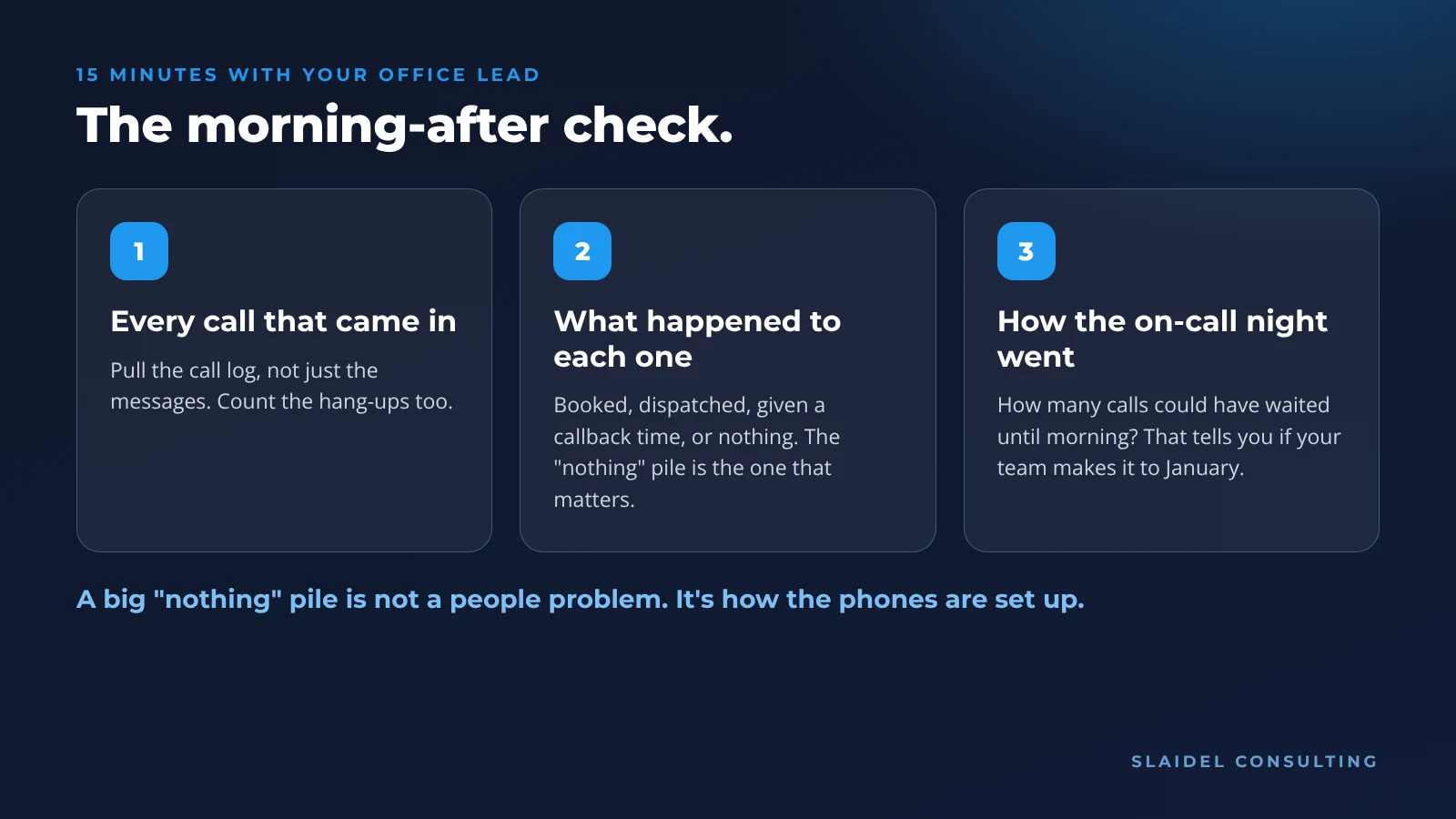
If the "nothing" pile is bigger than you'd like, or your on-call tech looks like he hasn't slept, that's not a people problem. It's how the phones are set up.
Where this fits
If you want the general version of this, read what happens to a lead after 5 PM. For the marketing side of the season, see why heating season HVAC marketing starts at the front desk, and how we work with HVAC companies.
After-hours calls are one part of a bigger picture: how every call, text and form gets answered, followed up and booked, at any hour. If you want to see how your business handles the whole path, from the first call to the booked job, the Revenue Diagnostic takes a few minutes and shows you where it's strongest and where it needs work.