

You hit a number and stuck there. Maybe it was $1M, maybe $3M. You added a tech, then another. You tried a new marketing company. This past year you bolted on a few AI tools. And revenue barely moved — the business just got busier.
If that's the shape of it, here's the uncomfortable good news: the problem probably isn't the market, the economy, or a lack of leads. It's something quieter, it's sitting inside your own operation, and it's the most fixable kind of problem there is.
Your business didn't stop growing because of the market. It stopped growing because it can't run without you.
Why do home service businesses stop growing?
Walk into a stuck home-service business and you'll almost always find the same thing: everything still runs through the owner.
You have people. What you don't have is a system underneath them. So the leads still slip, the follow-up is inconsistent, and the marketing only happens when you personally push it. The business can only grow as hard as you can push — that's the ceiling. It isn't your call volume and it isn't your market. It's that you are the load-bearing wall, and a building can only get so tall on one wall.
This is the distinction that changes everything: a team is not a system. People without a system don't remove the chaos. They just spread it across more hands.
Why don't more leads, more staff, or more tools fix it?
Because owners reach for the familiar levers, and each one disappoints for the same reason.
More leads. If jobs are slipping between "they called" and "it's booked," pouring in more leads just gives you more to lose. You feel busier and bank the same money.
More staff. More hands with no system means more handoffs, more "I thought you called them back," more jobs falling through a wider crack. Headcount multiplies whatever's already there — and if what's already there is disorder, you just bought more of it.
More tools — and lately, more AI. Everyone spent the last year adding a chatbot, a few automations, some setup a vendor sold them. And most of it went nowhere: time and money spent babysitting tools that don't talk to each other and don't produce a single booked job. Not because AI is useless — because AI on top of no system doesn't fix the business, it just makes the mess move faster.
The common thread: none of these is a system. They're parts. And parts don't run a business. A system does.
The shift most contractors haven't noticed: your customers are asking AI
Here's a change that happened faster than almost anyone in the trades realized. The share of consumers who used an AI assistant to find a local business jumped from 6% to 45% in a single year (BrightLocal, Local Consumer Review Survey 2026). AI is now the #3 way people discover local businesses — ahead of Yelp — and in home services specifically, 22% of homeowners now use tools like AI answer engines to research or find a service provider (Scorpion, 2026 State of Home Services Marketing Report).
Now the gap that should get your attention: in that same home-services study, 80% of business leaders admitted they don't know how to show up in AI search at all. The customers moved. Most contractors didn't. So when someone asks an assistant "who's a good plumber near me," a name comes up — and right now it's rarely the business that never set itself up to be there. You don't lose that job in a fair fight. You lose it before you even knew the game changed.
This is exactly why "just bolt on a chatbot" misses the point. Being found where customers now look isn't a tool you buy — it's one job of a system that has to be built and then run.
In one year, AI went from 6% to 45% of how people find local businesses. Most contractors never noticed.
What does a growing home service business have that a stuck one doesn't?
Look at a home-service business that's actually growing and you'll find the same trait every time: the growth doesn't depend on the owner being in the middle of it.
There's a system doing three jobs, month in and month out — whether the owner is on a jobsite or on vacation.
1. It generates demand — and gets you found
A growing business has demand coming in on purpose, not by luck: consistent content, campaigns, and presence across the channels customers actually use. And there's a new front most contractors are ignoring — customers now ask AI assistants for a recommendation. "Find me a good plumber near me" increasingly gets answered by an AI, not a search page. If your business isn't set up to show up there, you're being quietly skipped while whoever is set up gets the call. Being found is no longer just Google. It's Google, the map, and the AI.
2. It captures and converts every lead
Every inquiry — call, text, form, message — lands in one place, gets answered fast, and gets followed up until it books or clearly says no. Most booked revenue lives in the second through fifth touch, and it's exactly those touches that vanish when the owner gets busy. A system doesn't get busy. It just runs the play, every time, on a pipeline where nothing dies quietly in someone's inbox.
3. It shows what's actually working
A growing business can see which dollar produced a booked job — not just a click or a "like." That's what lets the budget compound instead of guessing. Money goes where it's proven to convert, and the stuff that doesn't work gets cut fast.
None of that runs on hustle. It's installed once and then operated. The owner's job changes from doing all of it to running it.
Why your AI experiments didn't move the needle
If you tried AI this past year and it didn't turn into money, you're not behind — you're in the majority, and the numbers are stark. 58% of small businesses now use generative AI, roughly double the rate from two years ago (US Chamber of Commerce, 2025). But adoption and results are not the same thing: a widely-reported MIT study found 95% of company AI pilots delivered no measurable financial return, and separate enterprise research saw the share of organizations abandoning most of their AI initiatives jump to 42% in a year, up from 17% (S&P Global, 2025).
Sit with that. Almost everyone is adopting; almost no one is getting paid. And the research is consistent about why — it isn't the technology. It's that AI got bolted onto a business with no system underneath it: solving a problem that wasn't the real one, owned by no one once it drifted.
AI is leverage, not strategy — it amplifies whatever it's pointed at. Point it at a clear system and it makes you faster. Point it at chaos and it just makes the chaos faster and more expensive. The system has to exist first; then AI makes it hum.
How do you know if you're the bottleneck?
You don't need a dashboard for this. Be honest about a few signs:
- Growth tracks your personal energy — busy months when you push, flat months when you don't.
- The phrase "did anyone follow up with them?" gets said out loud, regularly.
- Taking a week off feels like more work than staying, because everything waits for you.
- Every real decision — pricing, a tricky customer, who calls back — still routes to your phone.
- When you get slammed on the tools, response time and follow-up are the first things to slip.
If three or more are true, the ceiling isn't your market. It's that there's no system carrying the load you're carrying by hand.
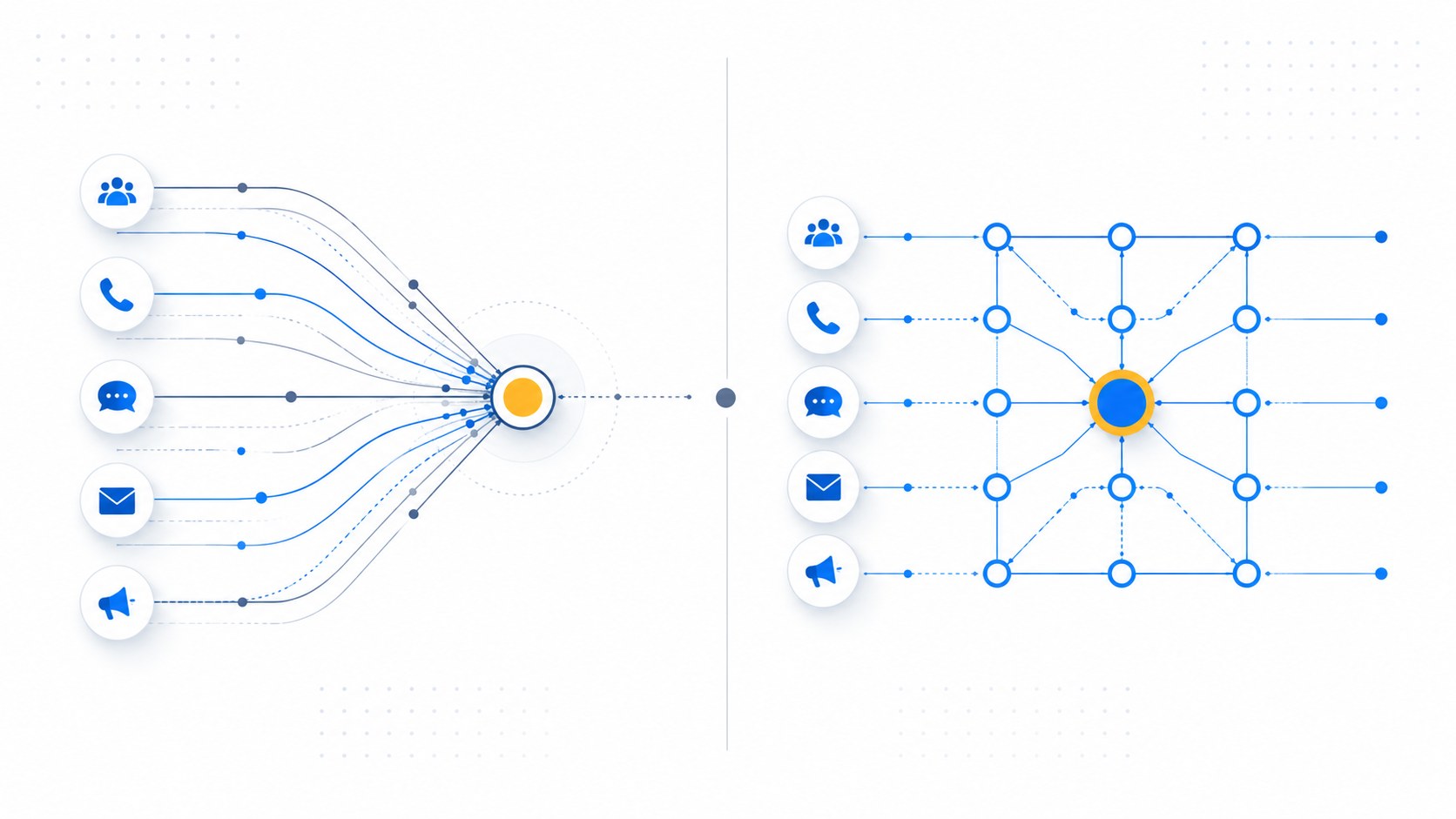
Owner-run vs. system-run (the shift)
A business run by the owner
- Growth rises and falls with your energy
- Leads answered "when someone gets to it"
- Follow-up depends on who remembers
- You can't fully step away
- Every decision waits for you
A business run by a system
- Demand comes in on purpose
- Every lead answered in seconds, 24/7
- Follow-up runs until it books
- The calendar fills whether you're there or not
- You lead instead of chase
That's the whole game — moving your business from the left column to the right.
What actually restarts growth?
Not a new tool. Not more leads. A system — installed, then run.
The move is to take those three jobs off your plate and put them onto something that operates whether you're there or not. Once that machine runs, your role stops being "answer everything, chase everyone" and becomes "lead the business and hold the standard." That single shift — from being the engine to running it — is what takes a business off its plateau.
Stop being the engine. Start running it.
Isn't this just "automate everything" — another AI promise?
No — and this part matters, because it's probably why you got burned before.
This is not a magic button. A system doesn't run a business you've checked out of, and anyone selling you "set it and forget it" is selling you the exact thing that disappointed you last time. You still make the calls, do the work you're great at, and enforce the standard — the system only holds because you lead it. What changes is that you stop being the single point every lead, every follow-up, and every campaign depends on.
The takeaway
If your home-service business stalls the moment you stop pushing, that isn't a motivation problem, a market problem, or a "need more leads" problem. It's a system problem — and of all the ways a business can be stuck, that's the most fixable one there is.
Sources
- BrightLocal, Local Consumer Review Survey 2026 — AI local-discovery adoption (6% → 45%); AI now the #3 local discovery channel.
- Scorpion, 2026 State of Home Services Marketing Report — 22% of homeowners use AI to find a provider; 80% of home-service leaders unsure how to appear in AI search.
- U.S. Chamber of Commerce, Empowering Small Business (2025) — 58% of small businesses using generative AI.
- MIT (Project NANDA), State of AI in Business (2025) — 95% of company AI pilots showed no measurable financial return.
- S&P Global Market Intelligence, Voice of the Enterprise: AI (2025) — AI-initiative abandonment rose to 42%.