

When revenue slows, most service business owners reach the same conclusion: "We need more leads." So you scale ad spend, hire an agency, rebuild the website — and inquiries climb. But revenue barely moves while stress spikes. The team's overwhelmed, response times slip, follow-ups fall through. You generated more demand than ever and profit stayed flat. That's the tell: you don't have a marketing problem. You have an operational breakdown that more marketing just made easier to see. The name for what's happening is revenue leakage.
The reframe: Marketing is visible — clicks, leads, calls. Operational weakness hides. So leaders try to fix an invisible problem with more volume. Volume doesn't fix operational friction. It exposes it.
The illusion of the demand problem
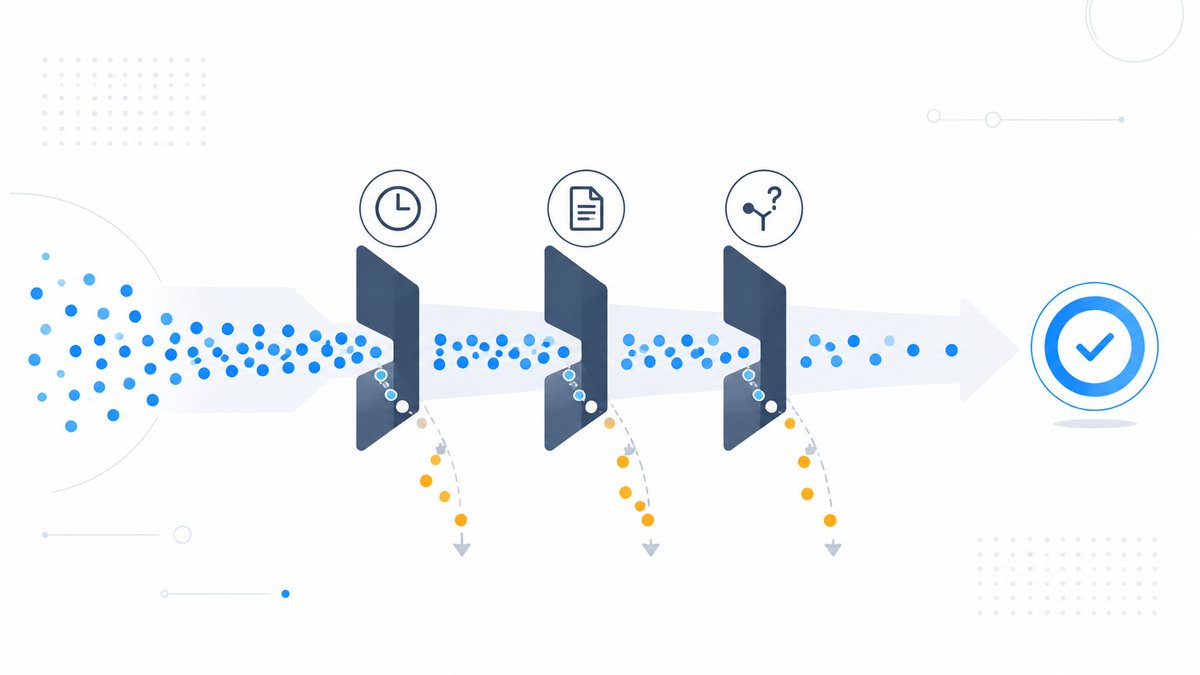
Marketing is attractive because it's measurable. Operational gaps are experts at hiding. A lead that never gets a response doesn't announce itself. A quote that took four days instead of four hours doesn't show up on your P&L. A dropped handoff between two people never triggers an alert. The damage happens quietly — so leadership pours volume onto a problem volume can't solve.
Revenue leaks in drops, not buckets
Owners picture lost revenue as a dramatic event — a big client canceling. Real loss looks different. It's the one missed call on a busy Tuesday. The estimate that took four days. The prospect who picked a competitor because nobody called back before the weekend. None of these feel significant alone. But hundreds of them over months become a serious drag — and you end up spending more on ads just to hold your baseline, because operations eat a slice of every new opportunity.
Most businesses don't lose revenue in dramatic failures. They lose it in hundreds of small moments that accumulate.
Growth amplifies structure — or the lack of it
A common myth says scaling creates chaos. It doesn't. Growth amplifies whatever structure already exists. Picture two businesses, both handling 50 inquiries a month:
Business A — has structure
Clear ownership, full pipeline visibility, defined standards. Scale it to 200 inquiries and it handles the volume cleanly.
Business B — runs on memory
Assumptions, informal texts, no defined ownership. Scale it to 200 inquiries and it implodes — same campaigns, opposite result.
The campaigns worked. The demand was real. Business B just lacked the operational scaffolding to capture it.
Control must precede growth
One of the most expensive assumptions is that you'll fix the internal process after you scale. Pursue growth without control first and complexity multiplies faster than your team can manage — which is why some businesses get less profitable as they get bigger. Hiring doesn't fix it either: add people to ambiguous ownership and you just create more handoffs and more diluted responsibility. The sequence runs one way:
What to fix before you spend more on marketing
Before adding fuel, look at the furnace. Three fixes recover more revenue than most ad budgets:
- Ownership. Every lead gets one named owner the moment it lands — no shared inbox, no assumptions. This is where most follow-up quietly fails.
- Speed. Set a response-time standard and flag anything that breaches it. The first responder usually wins the job.
- Visibility. Put every lead in one place so you can see where they stall. You can't fix a leak you can't see — visibility comes before control.
This is the whole idea behind why revenue leaks: fix how demand is handled before you spend more to generate it.
The point
Marketing matters and demand generation matters. But before you pour more fuel on the fire, look at the furnace. Stop asking "How do we get more leads?" and start asking "What exactly happened to the last 50 leads we got?" The answer to that question is where your real growth is hiding.